Inward-turning air roll (IDW)
Air is drawn from the room side and discharged above the opening. The roll closes towards the interior. This arrangement is particularly relevant for balanced pressure, slight overpressure or sheltered entrances.
Facade wind pressure, stack effect and opposing openings can drive a strong cold-air inflow whenever a door opens. In tall lobbies or busy buildings, the effect may extend far beyond the immediate entrance zone.
An entrance air curtain is more than a vertical jet. Intake side, discharge position and pressure difference form a recirculating air roll. We compare inward- and outward-turning arrangements under the actual wind pressure.
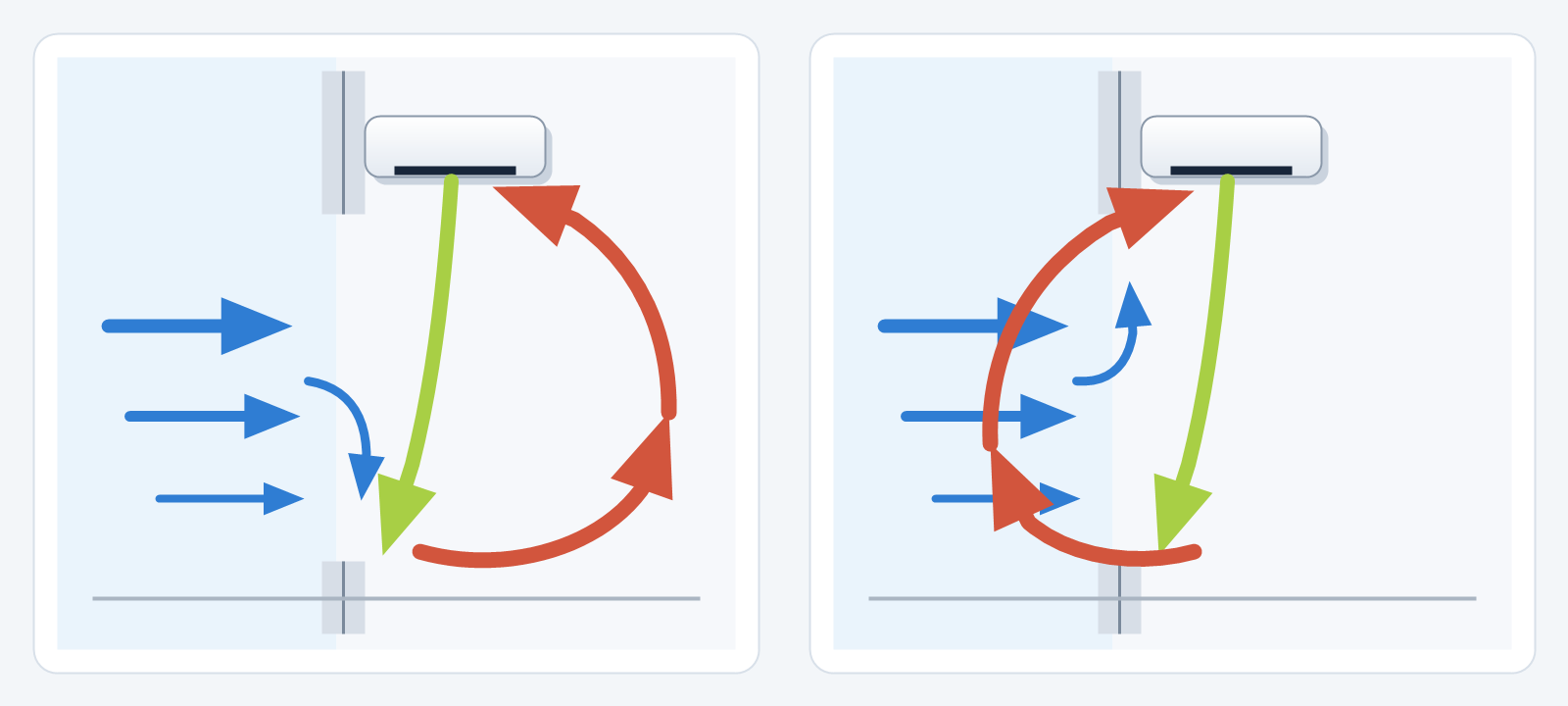
Air is drawn from the room side and discharged above the opening. The roll closes towards the interior. This arrangement is particularly relevant for balanced pressure, slight overpressure or sheltered entrances.
The air roll is directed against incoming outdoor air. It can provide a more robust barrier under negative pressure, exposed entrances or higher wind loads, but often requires more heating output.
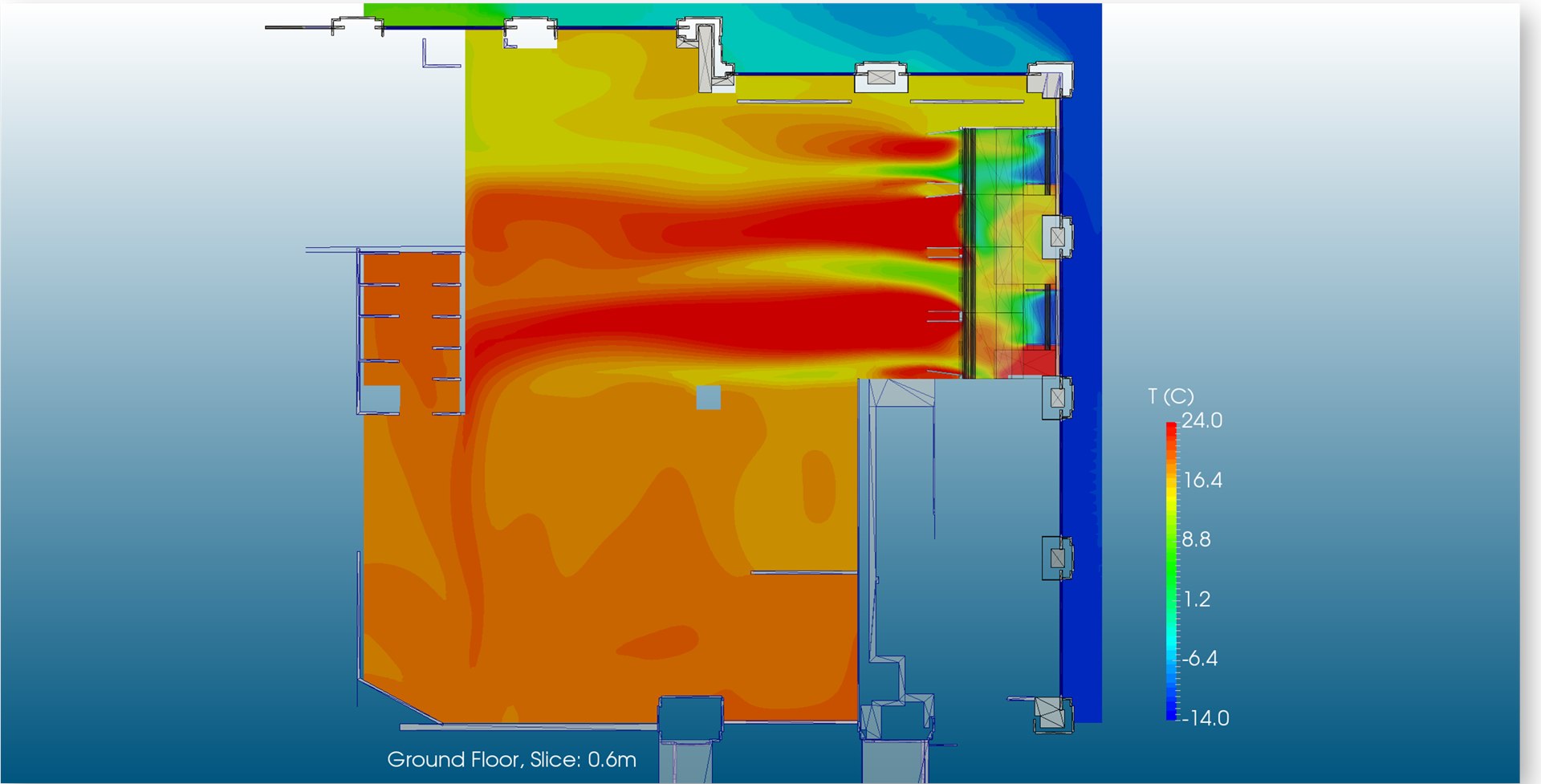
A horizontal slice shows how cold outdoor air enters through the doorway and mixes with warmer indoor air. The temperature distribution identifies penetration depth, affected occupied zones and remaining warm areas. Air curtain, vestibule and revolving door options are compared under identical boundary conditions.
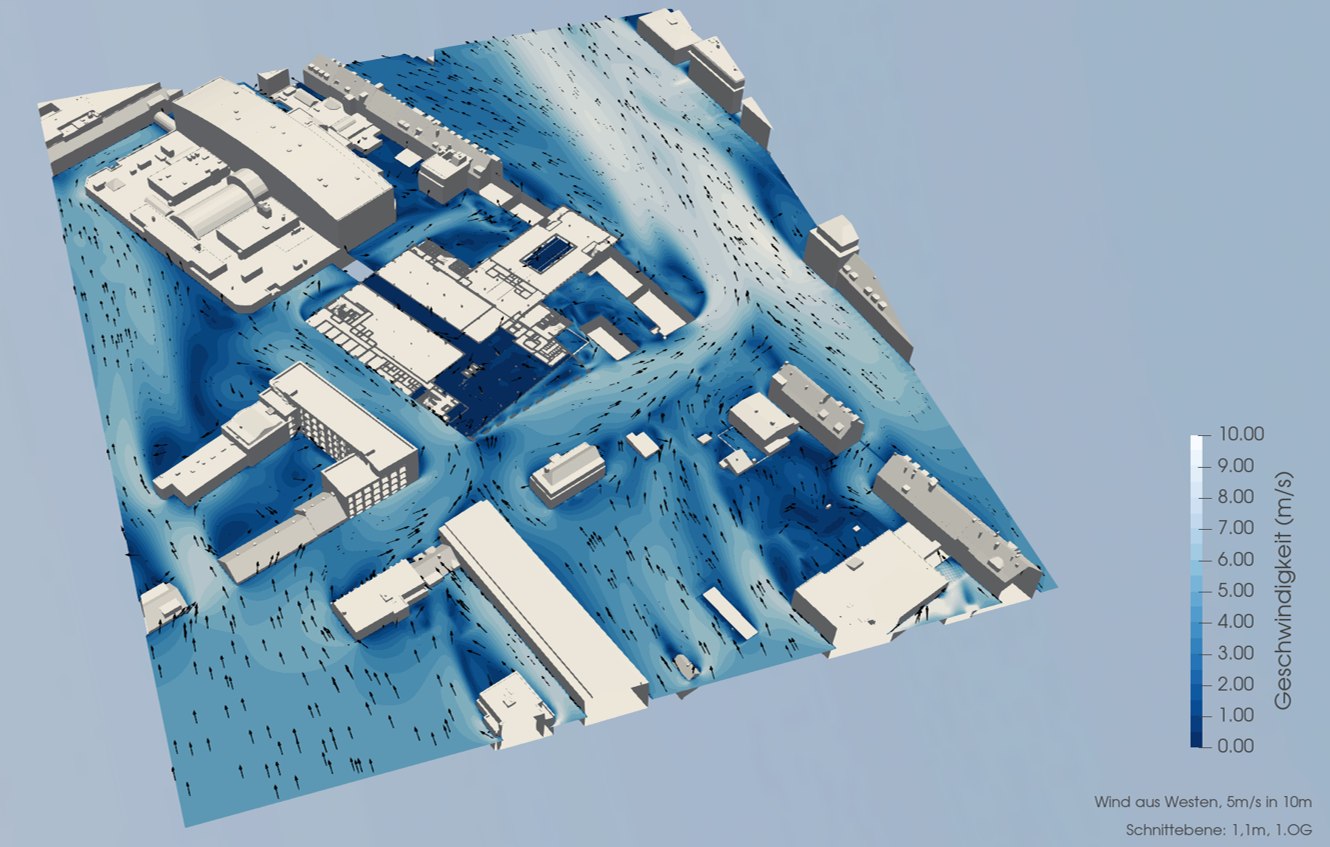
The velocity field shows how external wind pressure creates a concentrated jet at the opening that can reach far into the room. The transient simulation also tracks the resulting cold-air spread and room-temperature change. The same boundary condition is then applied to air curtains, revolving doors and vestibules.
Air curtains, revolving doors, vestibules and direct openings are compared under identical weather and usage conditions. Shielding performance and comfort are assessed together with heat loss and fan, heating and drive energy.
The reference case reveals unrestricted air exchange and the resulting heating loss.
Offset or sequential doors can reduce exchange with little additional energy.
Separated compartments limit exchange without a continuously heated air jet. Drive energy, rotation speed and pedestrian flow are included.
Air volume, discharge velocity, angle and heat output are optimised to block cold air reliably without wasting energy.
The transient simulation shows how outdoor wind deforms the air jet and pushes cold air through the opening into the interior. In the case shown, barrier performance deteriorates noticeably at an outdoor wind speed in the order of about 2 m/s. The precise limit depends on door geometry, pressure difference, discharge velocity and discharge angle.
Wind deforms the recirculating air roll and pushes cold outdoor air through the opening.
The rotating compartments limit direct air exchange while people pass through.
We analyse site-specific weather data and select both a cold winter design day and a representative average winter day. External flow around the building supplies pressure and velocity conditions for the open doors in the interior model. We then compare air curtains, revolving doors, vestibules and other options in steady or transient mode, including shielding, room cooling and energy demand.
Analyse a full year of temperature, wind direction and wind speed data
Select a cold winter design day and a representative average winter day
Calculate external flow around the building and surroundings for governing wind directions
Transfer pressure and velocity boundary conditions at open doors to the interior model
Assess system options by internal flow, shielding, room cooling and energy demand
The target is a solution that reliably limits cold-air infiltration and draught while using as little operating energy as practical. This avoids oversizing, reduces heating loss and enables demand-based design of air curtains or revolving doors.
For exposed entrances, high pedestrian frequency, tall lobbies, opposing doors or known draught complaints.
Transient analysis is particularly useful for short opening cycles and changing pressure conditions.
Yes. Dimensions, opening times, rotation speed and discharge conditions can be assessed under identical boundary conditions.
We define the door system, winter boundary conditions and suitable assessment criteria with you.